Top Strategies for Effective Service Company SEO
By Three Points Social | Local SEO & Google Business Profile Specialists
Service companies win online when people can quickly understand what they do, where they work, and why they are worth contacting. Effective SEO for a service business is not just about rankings; it is about turning local intent, trust signals, helpful content, and clear conversion paths into qualified leads. Whether you manage marketing in-house or compare SEO management companies, the strongest strategy starts with clarity and consistency.
What does effective SEO mean for a service company?
Effective SEO means making your business visible when potential customers search for the exact help you provide, then giving them enough confidence to call, book, request a quote, or send a message. For service companies, that usually includes local search visibility, service-specific pages, helpful educational content, reviews, technical website health, and simple conversion points. In practice, search engine optimization for business works best when it connects search intent to real customer needs instead of chasing traffic that never becomes revenue.
A homeowner searching for emergency plumbing, a business owner looking for commercial cleaning, and a manager comparing IT support providers all behave differently. Good SEO recognizes those differences. It gives each visitor a relevant page, clear next step, and proof that the company can solve the problem.
Strong local foundations drive better visibility
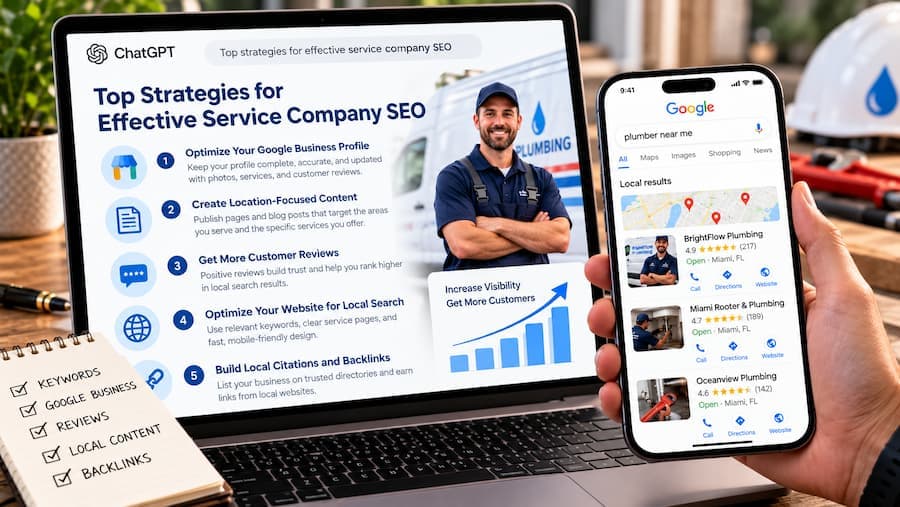
Most service companies rely on a defined service area, even if they do not operate from a public storefront. That makes local SEO one of the most important parts of the strategy. Search engines need consistent signals about your business name, services, location, service area, hours, and contact details.
Start with your Google Business Profile. Fill out every relevant field, choose accurate categories, add service descriptions, upload useful photos, and keep hours current. Your profile should match the information on your website and other listings. Small inconsistencies can create confusion for both search engines and customers.
Local SEO also depends on relevance. A general page saying “we offer home services” is weaker than a clear page for “water heater repair,” “roof inspection,” or “office HVAC maintenance.” The more precisely your website reflects what people are searching for, the easier it becomes to match their intent.
A practical local SEO checklist includes:
- A complete Google Business Profile with accurate categories and services
- Consistent name, address, phone, and website details across major directories
- Service pages for your highest-value offerings
- Location or service-area pages where they are genuinely useful
- Recent reviews that mention specific services and customer experiences
- Clear contact options on every important page
- Photos that show real work, vehicles, staff, equipment, or completed projects
This is also where many business owners begin searching phrases like “google best local seo company” or “search engine optimization agency near me.” Those searches can help you find support, but the real goal is not to hire whoever sounds the loudest. It is to choose a partner who understands local search, service-area businesses, and lead quality.
Service pages should answer buying-intent searches
Your service pages are often the most valuable pages on your website. They should do more than list what you offer. A strong service page explains the problem, describes your process, sets expectations, and makes the next step obvious.
For example, an example of good service company SEO would be a pest control company creating separate pages for termite treatment, rodent control, mosquito control, and commercial pest prevention. Each page would speak to the specific concern, include the service area, describe what happens during an appointment, and feature a clear call to action. That is much stronger than one generic “services” page with a short bullet list.
A useful service page usually includes:
- A clear opening that confirms the service and location or service area
- Common signs the customer needs the service
- A plain-English explanation of the process
- Benefits of choosing the company without exaggerated claims
- Trust signals such as reviews, photos, certifications, or experience if available
- Answers to common objections, such as timing, preparation, or what to expect
- A visible contact form, phone number, or booking prompt
The best pages feel helpful before they feel promotional. They show that you understand the customer’s problem and know how to guide them through it.
How should service companies choose SEO keywords?
Service companies should choose SEO keywords by combining service intent, location intent, and customer language. That means targeting terms people actually use when they need help, not just broad phrases with high search volume. A broad keyword like “seo” can be useful in context, but a more specific phrase such as “emergency AC repair in Dallas” or “commercial landscaping maintenance” is usually closer to a buying decision.
Think in groups rather than isolated keywords. A roofing company may need keyword groups for inspections, repairs, replacements, storm damage, roof types, and cities served. A consulting firm may organize keywords by industry, problem, service model, and decision-maker.
For a company offering search engine optimization services USA-wide, keyword planning might include national terms, industry-specific terms, and local searches. Phrases like “best seo service provider company” or “seo management companies” may attract prospects comparing vendors, while “search engine optimization agency near me” reflects a more local or convenience-based search. Each type of keyword deserves a different page or content angle.
Avoid forcing awkward keywords into copy. Search engines have become better at understanding natural language, so readability matters. Use primary keywords in important places, but write for the person who may become your customer.
Helpful content builds trust before the sales call
Not every visitor is ready to buy today. Some are researching symptoms, comparing options, or trying to understand whether they need professional help. Blog content gives your business a way to show expertise earlier in the journey.
For service companies, useful blog topics often come from real customer questions. A carpet cleaning company might write about pet odor removal, stain prevention, drying time, and how often to schedule cleaning. A managed IT provider might cover cybersecurity basics, backup planning, cloud migration, and signs a company has outgrown break-fix support.
Good educational content should:
- Answer one clear question or solve one specific problem
- Explain when DIY is reasonable and when professional help is safer or smarter
- Link naturally to relevant service pages
- Use examples that match real customer situations
- Avoid overpromising results or creating fear without context
- End with a useful next step, not a hard sell every time
This approach supports search engine optimization for business because it expands topical authority. When your website consistently explains related problems and solutions, it becomes easier for search engines and customers to understand what your company is known for.
Reviews and reputation strengthen local SEO
Reviews influence both visibility and trust. A potential customer may find you through search, but reviews often determine whether they click, call, or keep scrolling. For service businesses, recent and specific reviews are especially valuable because they reflect real customer experiences.
Ask for reviews at the right time: after a successful appointment, project completion, or positive customer interaction. Make the process simple with a direct link and a short request. Do not pressure customers or offer incentives that violate platform rules. The goal is an honest, steady flow of feedback.
Responding to reviews matters too. A thoughtful response to a positive review reinforces professionalism. A calm response to a negative review can show future customers that your company listens and takes concerns seriously. Even when a review is unfair, your reply is written as much for future readers as for the original reviewer.
Review content can also reveal language to use on your website. If customers repeatedly mention “on time,” “explained everything,” “cleaned up after the job,” or “easy scheduling,” those themes may belong in your service pages because they reflect what buyers care about.
Technical SEO keeps your website accessible
Strong content cannot perform well if the website is slow, confusing, or difficult for search engines to crawl. Technical SEO supports visibility by making sure pages load properly, work on mobile devices, use clean structure, and guide users without friction.
You do not need to become a developer to understand the basics. Focus on practical improvements that affect real visitors. Pages should load quickly, contact buttons should work, forms should be short enough to complete, and navigation should make services easy to find.
Important technical priorities include:
- Mobile-friendly page design
- Fast loading on key landing pages
- Secure browsing with HTTPS
- Clear URL structures that reflect services and locations
- Descriptive title tags and meta descriptions
- Proper heading hierarchy on each page
- Internal links between related services and articles
- Broken link checks and regular content updates
Technical SEO is often where professional help becomes useful. If your site has crawl errors, duplicate pages, poor mobile performance, or confusing architecture, an experienced provider can diagnose issues and prioritize fixes.
What separates good SEO providers from weak ones?
Good SEO providers explain what they are doing, why it matters, and how success will be measured. Weak providers rely on vague promises, secret tactics, or rankings without discussing lead quality. If you are comparing SEO management companies, look for strategic thinking, transparent reporting, and an understanding of your business model.
The best SEO service provider company for your business is not always the biggest or the cheapest. It is the one that can connect SEO activity to the outcomes you care about, such as qualified calls, form submissions, booked consultations, or service-area growth.
Before hiring a partner, ask questions such as:
- How will you learn about our services, customers, and service area?
- What pages or technical issues should be addressed first?
- How do you choose keyword targets?
- How will you report performance beyond rankings?
- What work is included each month?
- Who writes or reviews the content?
- How do you handle local SEO and Google Business Profile optimization?
- What do you need from our team to move quickly?
A reliable provider should answer in plain language. If every answer sounds like jargon, that is a warning sign.
Measurement turns SEO into a business system
SEO works best when it is measured as an ongoing business channel, not a one-time project. Rankings are useful, but they are only part of the picture. A service company should also track calls, form submissions, booked appointments, quote requests, and which pages influence those actions.
Look at performance by service and location. One page may generate a lot of traffic but few leads, while another may bring fewer visitors who convert at a higher rate. That insight helps you decide where to improve copy, add proof, adjust calls to action, or build supporting content.
Useful SEO metrics include:
- Organic traffic to service and location pages
- Calls and form submissions from organic visitors
- Google Business Profile actions
- Ranking trends for priority service keywords
- Conversion rates on key landing pages
- Review growth and rating trends
- Pages with declining traffic that need updates
- New content opportunities based on search queries
Review these metrics regularly, but avoid reacting to every small fluctuation. SEO compounds over time when strategy, content, technical health, and reputation keep improving together.
A practical SEO plan for service companies
If you are starting from scratch or trying to improve inconsistent results, keep the plan focused. Trying to do everything at once often leads to scattered work and weak execution.
Start with these steps:
- Audit your current website, listings, service pages, and Google Business Profile.
- Identify your most profitable or highest-priority services.
- Build or improve dedicated pages for those services.
- Add location relevance where it is accurate and useful.
- Create content around common customer questions.
- Improve page speed, mobile usability, and conversion paths.
- Ask satisfied customers for reviews consistently.
- Track leads and refine based on real performance.
This simple sequence keeps SEO tied to business value. It also helps internal teams and outside agencies stay aligned on what matters most.
The takeaway
Effective service company SEO is a mix of visibility, relevance, trust, and usability. Your website needs to explain what you do, your local presence needs to be consistent, your content needs to answer real questions, and your conversion paths need to be easy to follow.
Whether you handle SEO internally or work with a search engine optimization services USA provider, focus on building a system that attracts the right prospects and helps them take action. Rankings matter, but the real win is a steady flow of better-fit leads from people already looking for the services you provide.